Kriskras
2025
The invisible visible
in collaboration with Noorderlicht, Arcadia and Brouwerij Fortuna
On Vlieland, where the dunes not only shape the landscape but also sustain life, drinking water is extracted from a hidden freshwater lens beneath the island. Rain slowly seeps through the sand layers, is filtered, collected, and pumped back up – an age-old rhythm of falling, sinking, preserving. It is a system that remains invisible to the human eye but is vital for those who live here
and those who come here.
In this context, artists present works that make the invisible visible. They focus on processes that normally occur far beyond our perception: deep beneath volcanoes, in the veins of coal, or in underwater chasms where the earth deforms itself. Photography here is not used to register, but to reveal: as a kind of geological sensor, as a medium for time, pressure, heat
and transformation.
The earth acts as a camera, brush, and technology, as a bridge between knowing and imagining. Vlieland
thus becomes not only a place of observation but also of resonance – an island that echoes with underground stories, depicted by makers who listen to what occurs at the edge of sight and time.
This exhibition is part of Machine Entanglements, the thirtieth edition of the Noorderlicht Biennale. At six special locations in North Netherlands, more than seventy artists demonstrate how technology intertwines with our living environment. The Noorderlicht Biennale can be seen from July 12 – September 7, 2025 at Niemeyerfabriek & Tschumipaviljoen (Groningen), Museum Dr8888, Museum Belvédère, Tresoar Leeuwarden (Friesland), Brouwerij Fortuna / Into The Great Wide Open (Friesland, Vlieland), De Proef (Drenthe)
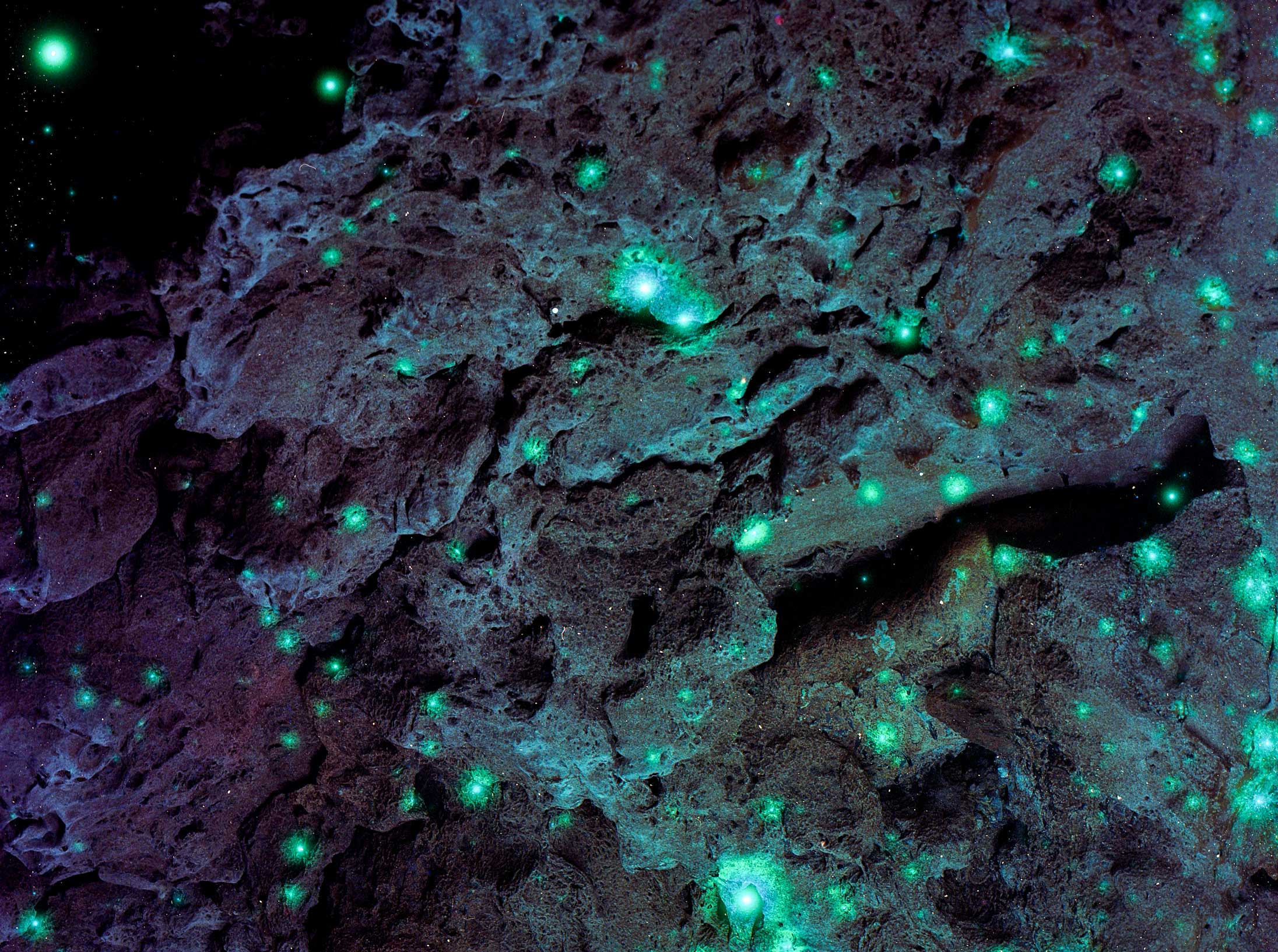
Louis Braddock Clarke, Silent Sun Splatter, bio-chemical auto-photography, 2025
In Silent Sun Splatter Louis Braddock Clarke investigates how the earth itself can create images. Within a volcanic network, deep beneath the Atlantic Ocean, photographic impressions are formed without human intervention. The location, the Triple Junction, is an exceptional geological crossroads where three tectonic plates pull apart, and where underground tunnels filled with rare metals, bacteria, and minerals emerge. These natural shafts function as living cameras: moisture, temperature, chemical reactions, and vibrations from human activity leave their marks on photographic negatives left by Louis. The 'selfies' that result combine geological time and human influences into a new form of visual language.
Louis Braddock Clarke (1996, GB) is a British artist and educator, working between Berlin and Amsterdam. His work oscillates between sound installations, experimental film, and critical design, often in collaboration with scientists, musicians, and institutions such as the Natural History Museum of Denmark and Utrecht University. Through speculative and immersive formats, Clarke explores planetary systems, extraction, and techno-ecologies. Projects like LAWKI (together with the collective ARK), Weather Gardens and Hard Drives from Space have been showcased at events including the Venice Biennale (Musica), Sonic Acts, and the Rewire Festival.
Michael Najjar (1966, DE), volcanic resublimation, hybrid photography, print, 2018
In volcanic resublimation Michael Najjar visualizes the formation of sulfur through volcanic activity. The photo was taken in the bizarre crater landscape of the Whakaari volcano, the only active volcanic island in New Zealand. Sulfur-containing gases shoot up from fumaroles – cracks in the Earth's crust – where they crystallize and cover the crater floor with a bright yellow layer of pure sulfur. What is visible on the surface is merely the tip of a gigantic underwater mountain that reaches 1,600 meters deep. The volcanic cone and the imposing sulfur walls are over two million years old. Najjar connects in this work the power of earthly processes with a cosmic perspective: sulfur plays a role not only on earth but also in the formation of other celestial bodies such as Mars, Venus, and the moons of Jupiter and Saturn. Due to the complex layering and color effect, the image appears to float weightlessly while simultaneously radiating enormous energy and primal power.
Hedwich Rooks (1995, NL), Ynfra, photographic and sculptural work with video, scans and experimental printmaking, 2024
With Ynfra Hedwich Rooks explores how life, technology, and matter are intertwined over time. Her work starts from coal: once living material, now a source of energy and a symbol of ecological disruption. During a residency at the former Zeche Zollverein mine, Rooks examined coal through medical imaging, such as MRI and CT scans, and chemical experiments. By representing the structure of coal with the same technology that was once made possible by that material, a poetic paradox emerges. In combination with photogrammetry, analog and digital photography, and printing techniques using geological pigments, she establishes connections between industry, ecology, and care. Ynfra makes palpable how technological systems arise from natural resources and how these resources carry forgotten bodies from the past.
Hedwich Rooks (NL, 1995) is a Dutch photographer and artist with a background in bio-art, material research, and lens-based media. From a speculative-ecological perspective, she examines how bodies and landscapes transform through chemical, technological, and social forces. Her installations combine sculpture, video, and sound architecture, oscillating between the corporeal and the cosmic. She is a co-founder of the collective Acid Salt and has recently collaborated with various organizations including FIBER Festival, Bioart Society, and Brutus.
This exhibition is a collaboration between Noorderlicht, Arcadia, and Into The Great Wide Open.