Tijl Couzij: It can also go wrong
About the sustainable ambitions of Into The Great Wide Open

2025
Interview
DATE
WRITTEN BY
Ruben van Dijk
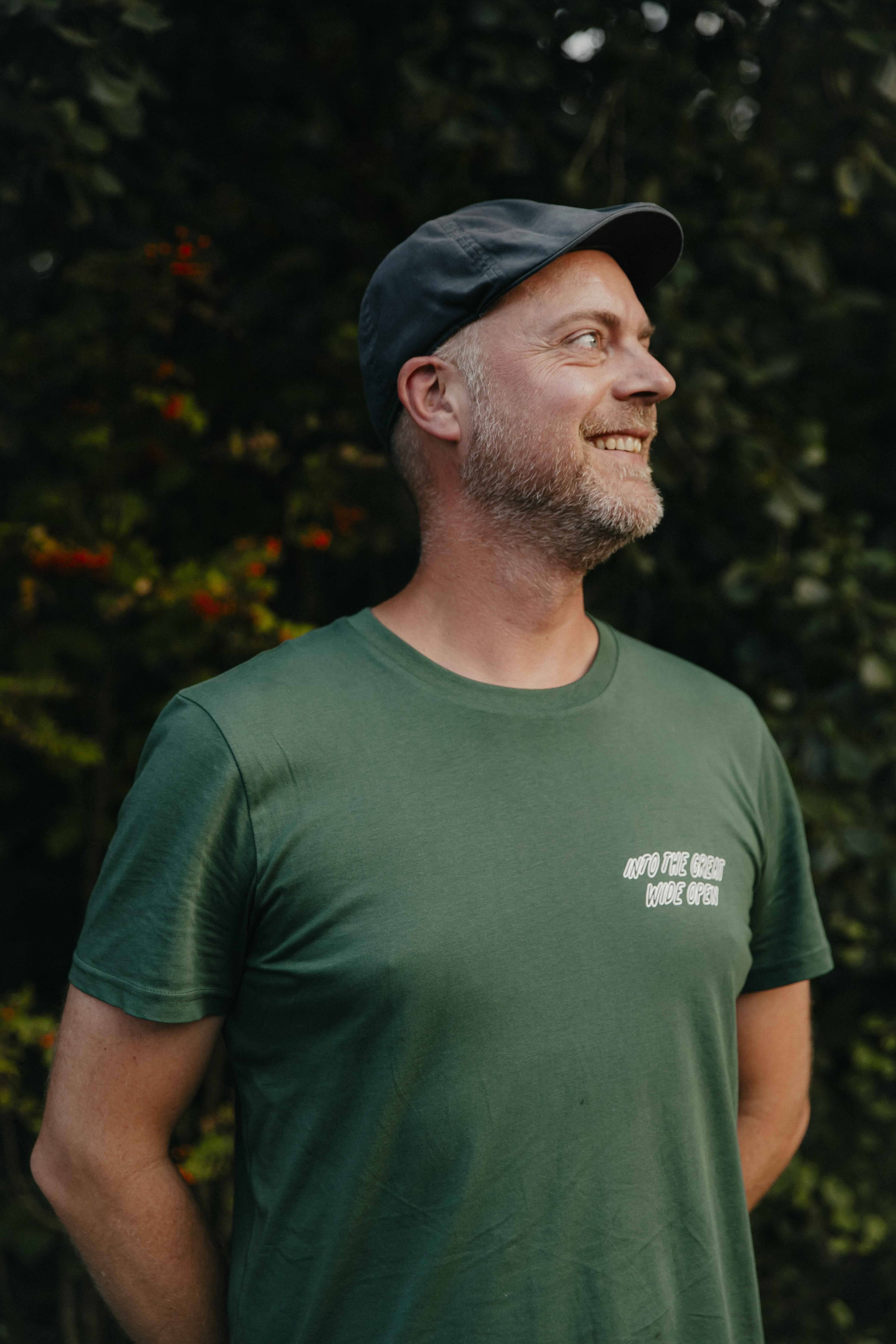
One and a half months before the first edition, Tijl Couzij came on board as a 'crisis producer' at Into The Great Wide Open in 2009. He is now building not only a future-proof and fossil-free festival with Lab Vlieland, but is also collaborating with, among others, the construction and transport sectors on drastic sustainability measures that extend far beyond Vlieland. He introduces us to the 'Building Site of the Future': a fully functional testing ground – biobased and emission-free. Couzij: “Festivals have the potential to be drivers for the transition to a circular, climate-positive, and regenerative society.”
For a few years now, the word has appeared in the reporting of Into The Great Wide Open regarding the theme of sustainability: climate positive. The festival not only aims to be emission-free in the long run, but also to absorb more greenhouse gases than it has ever emitted. In short, the logic is that Vlieland – and the earth – would be better off with a climate-positive festival than without one. It sounds too good to be true. Tijl Couzij believes it is possible.
In the summer of 2009, Couzij became involved with the festival that was then just a month and a half away from its first edition. "A lot had been thought out in advance, but very little was concrete," said Couzij. As an 'emergency producer', he quickly gets everything up and running with the whole team. "After that, I said: I don’t want to keep playing that producer role. Starting a new festival was fun, but now that there is a festival, I enjoy working on innovation much more." Couzij becomes a co-founder of Lab Vlieland. In parallel to the festival organization, Lab Vlieland focuses on "research and development" and positions itself as a driving force for sustainability – both within and outside the festival world – with ITGWO as a testing ground.
From the lab's creative mind, various ideas have emerged in the past editions, allowing ITGWO to be 95% emission-free and fully fossil-free in its direct energy supply by 2024: almost all electricity came from the Vlieland solar field, with a small portion from green hydrogen. For a short time, emergency generators were needed, burning HVO (second-generation biofuel). "If everything goes well, we will also be 100% emission-free in our energy supply this year," hopes Couzij. No greenhouse gases, and also no fine particles, nitrogen, and sulfur oxides.
The 'historical emissions' from all previous editions (about 6000 tons) are now being offset by the festival with natural CO2-binding projects.
Drivers
But getting direct emissions to zero is still far from enough, because "festivals are very dependent on the surrounding infrastructure – for transport and the movement of people and goods," especially on an island. Those so-called scope 3 emissions, indirect emissions from the supply chain and visitors' travels, cannot be solely reduced by the festival.
According to Couzij, there lies enormous potential in this area that far too few festivals are taking advantage of. "Festivals are more flexible than many other parties, because they exist for only four days a year. Festivals are used to making quick adjustments, as they often work with creatives who may think at the last minute: no, those lights are totally wrong. No one finds it very pleasant, but everyone is prepared for it, while large companies often have to go through an entire workflow. It can take them months, sometimes years, to make decisions."
The goal of Lab Vlieland is to lower the threshold for suppliers as much as possible and to provide a stage for their experiments. "Suppose we tell a supplier: we would like you to provide us with fossil-free services. Then the supplier says: yes, but we can’t do that at all, because this and that is difficult. Well, then we say: come on, it is possible. We want it, and we will help you. We are your launching customer. Come and try it out. It’s okay if it fails!" This way, several pilots in Vlieland have also contributed to greening outside the festival sector. "I remember that the CEO of Greener Power Solutions was writing the software for his first battery in the middle of the night in a tent at our campsite. Now, that is one of the largest mobile battery companies in Europe, and not the festival market, but the construction and energy sector is their primary market."
Bouwplaats van de Toekomst
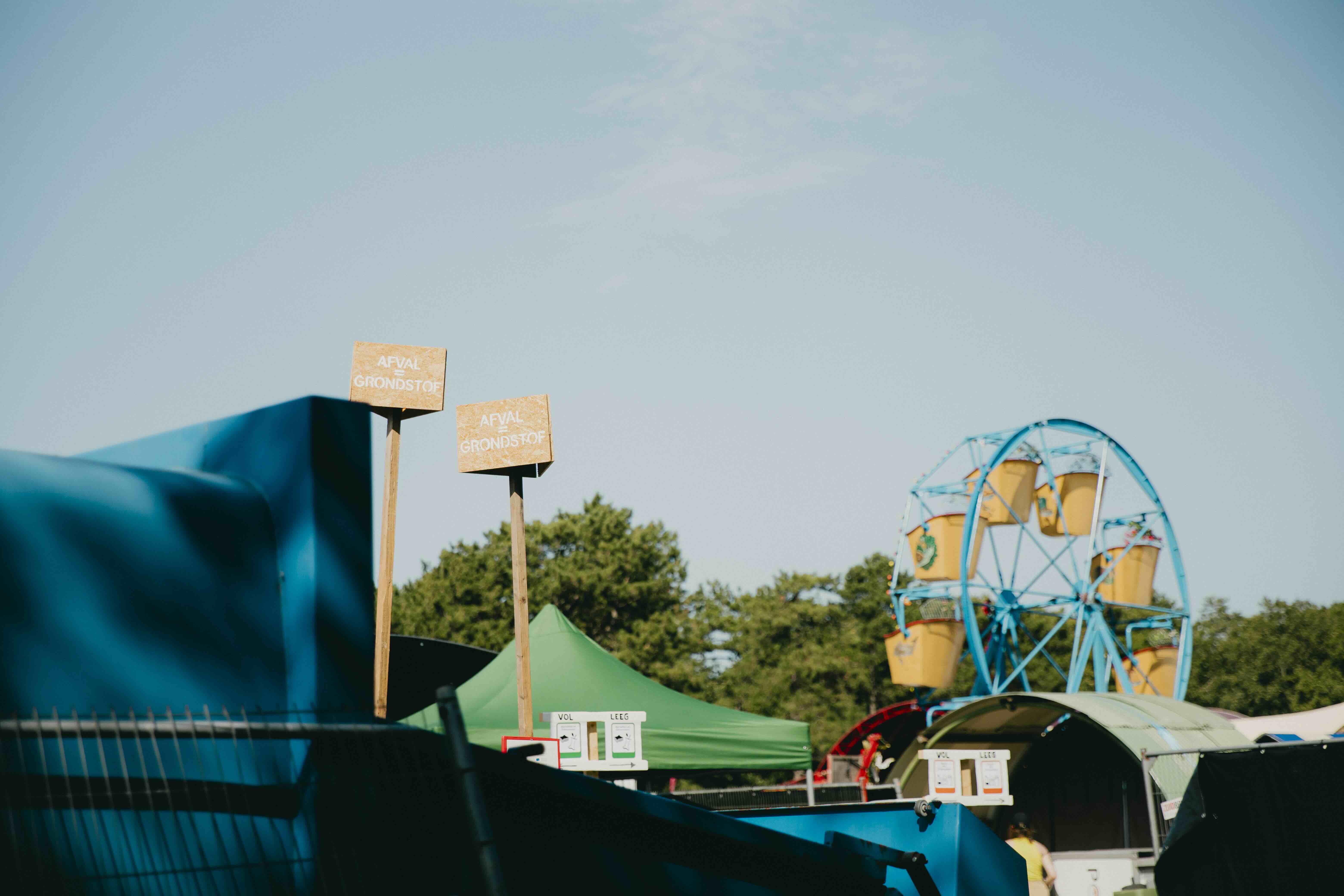
When Couzij talks about Bouwplaats van de Toekomst, it is not just a testing ground, but a functional construction site. For ITGWO 2025, part of the construction will be done as will be required everywhere in the future: using green power, with fully electrified equipment and biobased building materials. "It is the culmination of all the small projects we have done in recent years."
Why the emphasis on construction? "We have seen that the construction and festival sectors have a considerable overlap. Construction companies also need to suddenly have access to a lot of power somewhere in the middle of nowhere, where there are no major connections. Also, regarding long-distance transport and the use of fossil building materials, they face exactly the same challenges."
As early as 2024, a partnership began with several construction companies, allowing for the switch to electric forklifts and other emission-free equipment. For Bouwplaats van de Toekomst, this collaboration will be significantly scaled up with partners such as BAM, TBI, Stichting Doen, Triomf, Team Infra, and Voskamp Groep, and the door will be opened for other parties. Couzij: "Basically, we say: hey construction sector, come look at us! Let’s ensure that what we do smarter at our festival ends up at the more than 3500 construction sites of BAM and TBI – and that what they do smarter comes to the festival sector. Let’s help each other accelerate that transition."
Bouwplaats van de Toekomst doesn’t build anything new, but builds differently what is already built each year. A good example is The Shop on the Sports Field: "We have been using reused materials and demountable structures for years, but until now the emphasis has not been specifically on biobased." This year, Bouwplaats van de Toekomst called out to everyone who could lend, donate, or sell innovative biobased building materials. "Our construction parties and we can eventually monitor how those materials work and how the building performs in practice."
Extremely Good Journey
A festival exists by the grace of its visitors, which also means that a festival is only emission-free if all visitor travels are, no matter how green you build. In 2018, about 70 percent of festival visitors arrived by fossil car to Harlingen, last year that was still 50 percent. It remains by far the largest source of emissions – and so ITGWO is stepping it up this year: more festival buses, a first-mile taxi service, electric car sharing, luggage service – all fossil or emission-free - more already set up tents, an increase of the Good Travel Allowance to fifteen euros, and a true FIP program ('fossil-free important person') for anyone who has arrived in Vlieland emission-free.
These remain incentive measures – and thus the festival relies on its driving function and the behavior of the visitors. The visitor who, once in Vlieland, uses fully green energy for four days, produces little waste and thereby lives many times greener than the average Dutch person. Couzij hopes ultimately to bring about behavioral change by setting a green example: "Most of our decisions are made subconsciously. Therefore, we hope to make the connection between sustainable choices and ‘the best time of your life,’ so that our visitors start to feel: hey, sustainable choices can also be the more enjoyable, pleasant, nicer choices. It doesn’t have to be a punishment for anyone."
With a construction site full of biobased materials and completely silent construction machinery, Couzij aims to achieve a similar effect: “I want people to realize that more sustainable choices don’t just revolve around what you have to do less of, but that it can ultimately be much cheaper – and that it actually produces more things that are truly important."