A world where home is drifting further away – in conversation with Juul Hondius, Montaser Alsabe, and Abed Hussein
An interview by Ruben Jacobs (Mister Motley)


2026
Interview
DATE
WRITTEN BY
Ruben Jacobs
Due to climate change and an accumulation of crises, our planet is becoming an increasingly inhospitable place. Consequently, the question of who can remain living somewhere and who is forced to move on constantly echoes in the background. The film Tidal Settlers by Juul Hondius, which is part of the art program of Into The Great Wide Open and can be seen there from 27 to 30 August, zooms in on this question. Ruben Jacobs spoke with Juul and with Montaser Alsabe and Abed Hussein, who became co-creators during the process. 'Those who have to fend for themselves, leave. It is that simple.'
Five different screens are set up in a dark space. On those screens, we see scenes of a number of people trying to make their way through a tidal landscape of ebb and flow. Their names, backgrounds, and origins remain unknown. The horizon is endless, a point of reference is missing. That these people are surviving is immediately clear. With wood, plastic, rope, and other found materials, they build rafts and small boats to brave the ever-rising water. There is barely any solid ground; everything is constantly in motion.
In Tidal Settlers, humans seem to have to adapt to a world where home is increasingly slipping out of view. Not a distant, fictional future, but a reality that comes strikingly close. The rising water can be read not only as a reference to climate change, but also as a metaphor for the many crises that force people today to leave their familiar surroundings: war, conflict, political instability. The question of who can stay and who is forced to move on, therefore, constantly echoes in the background.
It evokes an oppressive feeling. As a viewer, just like the refugees depicted, you are placed right in the middle of the situation and can hardly escape the question: how would I react if I found myself in these circumstances? The sea is an important entry point. As a force of nature familiar to many Dutch people, Juul Hondius believes it can help bring the audience closer to the experience of displacement.
But how do you tell a story about refugees without reducing them to numbers, victims, or stereotypes, but showing them as people like anyone else? How can you, as a creator, evoke a sense of displacement?
Displacement
Juul himself has no experience with displacement. However, he grew up with the stories of his mother; as a five-year-old child, she experienced the dramatic 'Flight of Breda'. The horrors of the war she saw and endured there made a deep impression on her life. And also on her son, because her stories have been in his head like a movie since his childhood. In a world where a new arms race seems to be taken more and more for granted, Juul wonders if we in Europe still truly realize what war means.
When Juul interviewed asylum seekers in Paris and Calais in 2010, his mother's stories merged with those of the people he met there. Their reasons for fleeing their homeland differed, but the underlying commonality was lawlessness and the danger resulting from it. Complete powerlessness against a state, criminals, or other people with bad intentions.
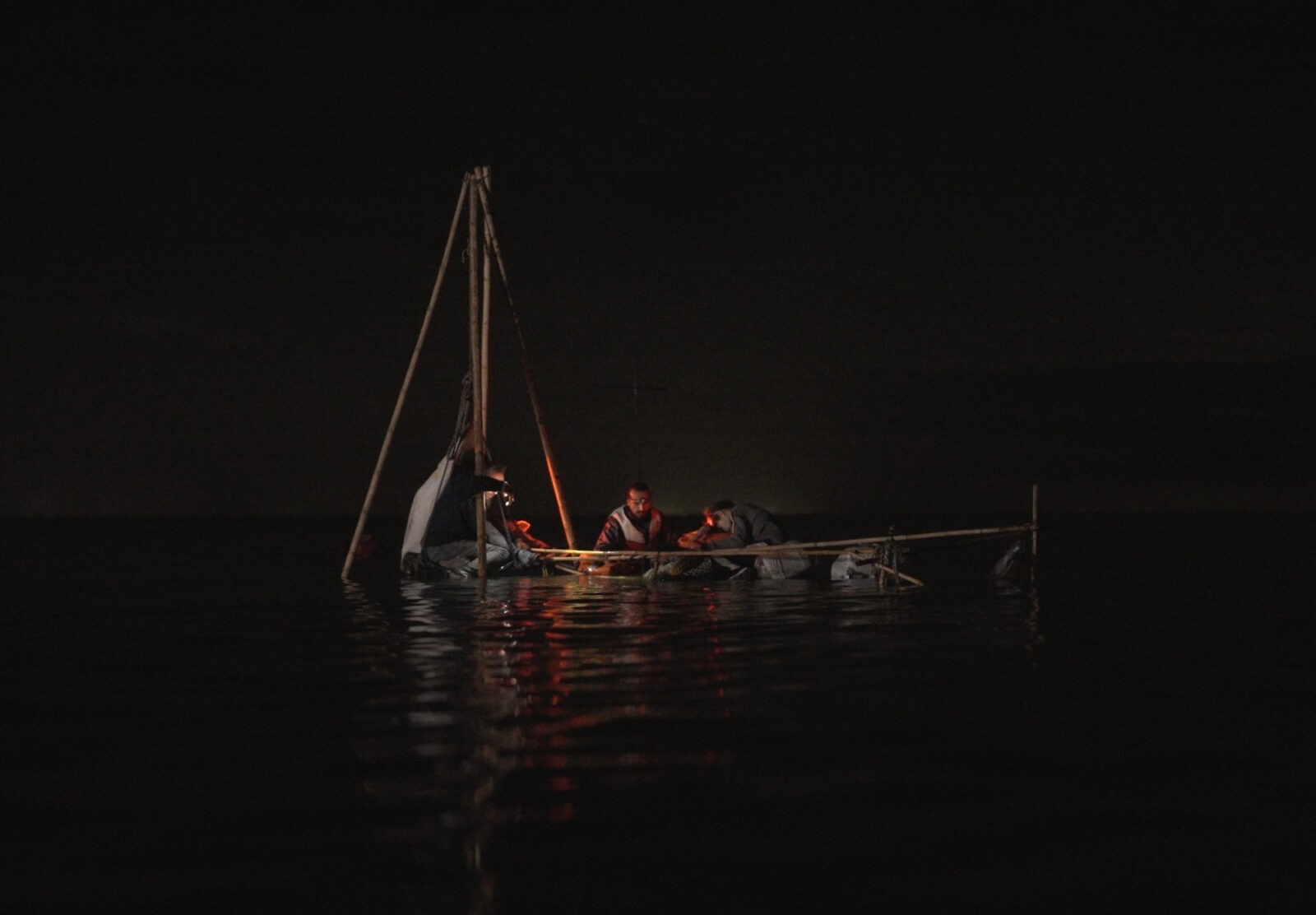
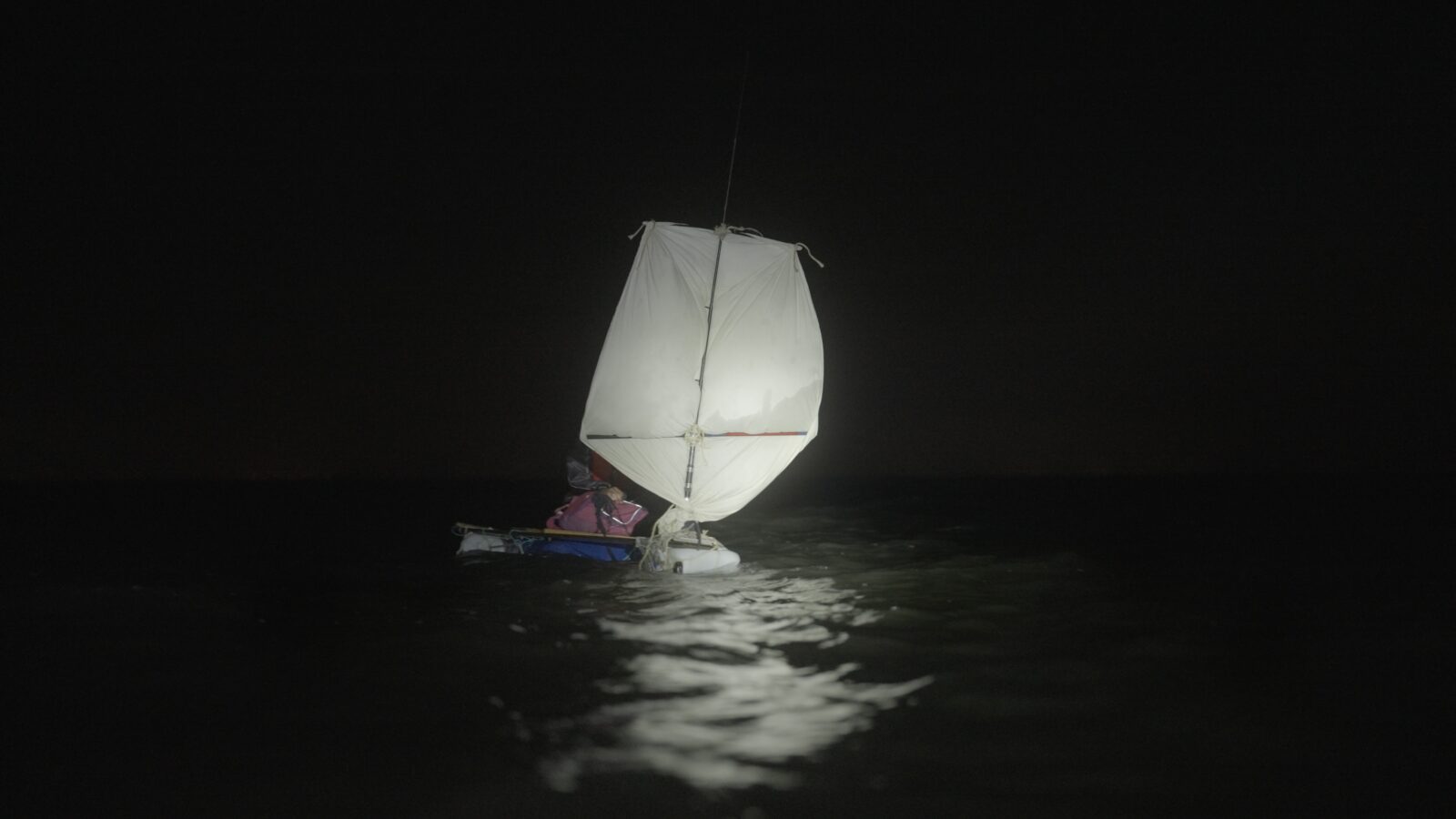
Juul Hondius - Tidal Settlers, filmstill ‘Night’, 2026
Empathy
Those who have to fend for themselves, leave. It's that simple. But from that moment on, your life is completely turned upside down and you begin a journey of which you do not know how it will end. Juul wants to make people aware of this. Cultivating empathy instead of fear of the other. From there, the idea arose to collaborate with refugees and migrants and make space for their stories. As a counterweight to the growing resistance, the polarization, and the ease with which asylum seekers are made scapegoats. Against this hardening, Juul opposes attention, humanity.
The collaboration started simply: a note on the bulletin board of Boost, a center in Amsterdam-East for newcomers with a refugee background and volunteers from the area. A place where people can expand their social network, exchange culture, learn the language, and develop further at their own pace.
The note read: 'People wanted for adventurous film project, acting experience not necessary but it does require some perseverance.' Two men responded: Montaser Alsabe and Abed Hussein. Neither of them was an actor, but both had a great passion for film and creative work. Moreover, in their country of origin, they are professionally active in the film world and were looking for a new opportunity to experiment, collaborate, and meet other people. When they met Juul, they saw the project not only as an opportunity to participate in an artistic work, but also as a space where they could apply their experience and passion while gaining a different experience.
In the weeks that followed, they worked together on a script. They conceived the structure, wrote out the scenes, and thought about the appearance of the actors: which jackets, which shoes? And about the props: plastic, wood, rope, things that are of vital importance in such a situation.
Earlier, Juul had already been inspired by an image from a television documentary about a group of fanatical mudflat walkers who crossed from Texel to Vlieland in 1963. The distance was so great that they could not make the crossing within the time of the tide. They took long bamboo poles with them and constructed a temporary, shaky shelter above the rising water in the evening. They called those constructions 'flooding chairs'. The next morning, they walked on. 'I saw that image as a starting point to tell a completely different story about displaced people.'
When Montaser and Abed joined the project, the idea grew that the bamboo construction was just one of the means to deal with the water. Other items and methods also found a place in the story. People and objects each got their own developmental arc within the script: individuals meet each other in that infinite space, but items also come together. They are shared, used, and passed on, after which both the people and the items go their own separate ways.
Juul Hondius - Tidal Settlers, film still ‘Raft’, 2026
Trust
In the beginning, it was mostly about testing the waters. Abed: 'The first meeting felt like the start of a path where it was not yet clear where it would lead. It took time before trust developed between us and Juul. But after a while, that initial distance turned into mutual trust. The conversations became more open and the work increasingly became a collaborative process.'
'Trust', that was the key word, according to Montaser, speaking via Zoom from Valencia, where he has been reunited with his sister for the first time in four years. 'You don't know how to assess someone, what someone's intentions are, what to expect from each other. The situation is still unclear, fluid, uncertain, just like the moment you flee your own country and have to find your way along with other strangers in a new country, where you still have to learn the language, the customs, everything.'
'That applied to me as well,' Juul adds. 'This collaboration was exciting for the three of us in the beginning. Aside from the language barrier, it was also a question of what exactly we could expect from each other. Along the way you find out what everyone's qualities are, and then your cultural background is still important, but soon we were speaking the same artistic language with each other. That was instructive and funny. You have to explain everything to each other about certain daily and social matters, while something like writing a script or making a storyboard has a universal language.'
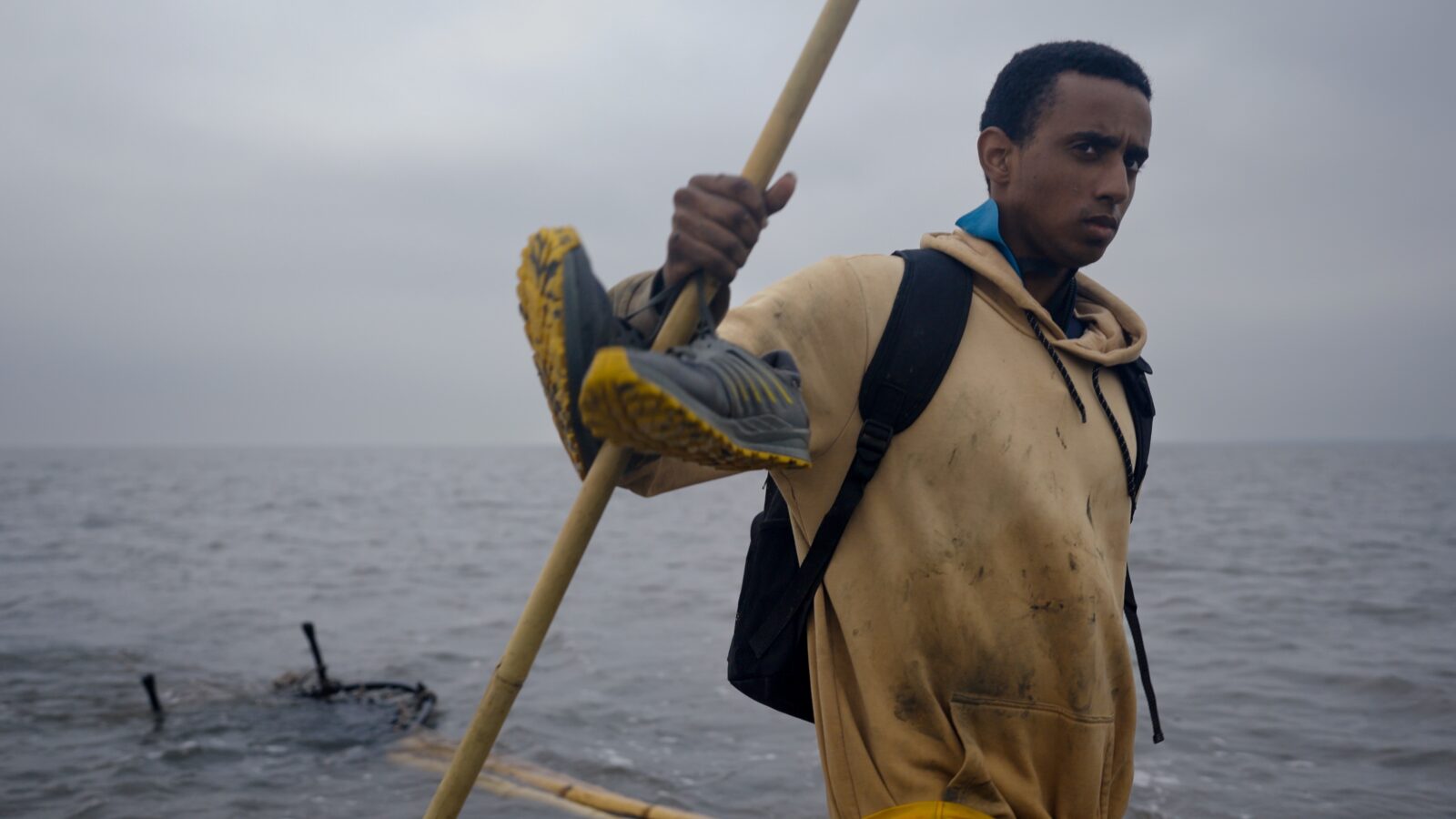
Juul Hondius - Tidal Settlers, film still ‘S’, 2026
Precarious
The shooting week in the middle of the sea was an exceptional experience for both crew and cast. By no means everyone on board knew how the tide works or had ever stayed on a ship. Juul: 'And I felt that it was also precarious in a way, because we were reenacting scenes that were recognizable and sometimes painful for the actors. One of the actors had been on a boat in the Mediterranean herself, but said she could easily distance herself from that. Another actor felt during filming that she was experiencing something of what her parents went through when they left China for Taiwan for good. That was very powerful.'
A few weeks after the shooting, the attacks of October 7, 2023, took place and suddenly all spotlights were on the Israeli-Palestinian conflict. Everything seemed to become black and white.
During that time, Montaser and Abed were in constant uncertainty regarding the fate of their family members and friends in Gaza. 'Since then, in certain situations, we prefer not to say that we are from Gaza,' Montaser says. 'Everything has become political, whereas we actually don't want to deal with that at all. We just want to live.' The fact that Montaser and Abed's families were able to come to the Netherlands also temporarily made the collaboration more complex.
Abed: 'We constantly had to switch between working on the scenes and thinking about the war, between trying to build a new artistic world and worrying about our families. The reality surrounding the project was no longer just a background, but became part of our daily lives.'
Evoking Questions
But now the work is here. On ITWGO, Tidal Settlers can be seen among the trees of Vlieland, with the salty sea air never far away. Juul, Montaser, and Abed are all present at the festival. What do they hope the audience takes away with them afterwards? Montaser: 'I hope people go home with questions about what our shared future should look like. About newcomers, about us as new neighbors'.
'Neighbors, not farmers,' Juul corrects (noting a Dutch homophone slip).
'He is a good teacher,' Montaser laughs.
Abed nods. Juul adds: 'It is not a bad thing if visitors walk away with some confusion afterwards. As an artist, you don't want to fill in everything for your audience. Besides evoking empathy for the 'stranger', you also want to raise questions such as: who are these people and what do I think of them, is the oppressive feeling about my own fears or am I wondering how things will turn out for these people?'
It has gone dark on one of the screens. The horizon has disappeared. The only thing that gives depth is a small, assembled sailboat, behind which is a person with a lamp in his hand illuminating the white canvas, something that looks like a sheet. A poetic image, reminiscent of the paintings of Caspar David Friedrich: lonely figures in a vast, unfathomable world. And at the same time, it has something hopeful: an image of human ingenuity and survival instinct, an attempt, despite everything, to get solid ground under one's feet again.
This interview was written by Ruben Jacobs on behalf of Mister Motley.