The Good Journey
Climate-neutral travel and transport


About half of our climate footprint comes from travel and transport. Most of that is due to cars: in 2025, 49% of visitors still arrived in fossil-fueled vehicles, collectively accounting for about 1.2 million kilometers.
That needs to change. The goal of the Good Journey is to reduce those emissions as much as possible, and ultimately to zero. This is how we are doing it:
1. We make fossil-free travel to Harlingen as easy as possible. Together with Handpicked Agencies, we built the Good Journey Planner this year. Enter your city of residence, your group, and your preferences, and you will get your personal Good Journey options at a glance. No more hassle figuring things out.
2. We prevent emissions. Smarter transport plans, bundling cargo at central hubs, more efficient vehicles, purchasing more locally, and more reuse on the island.
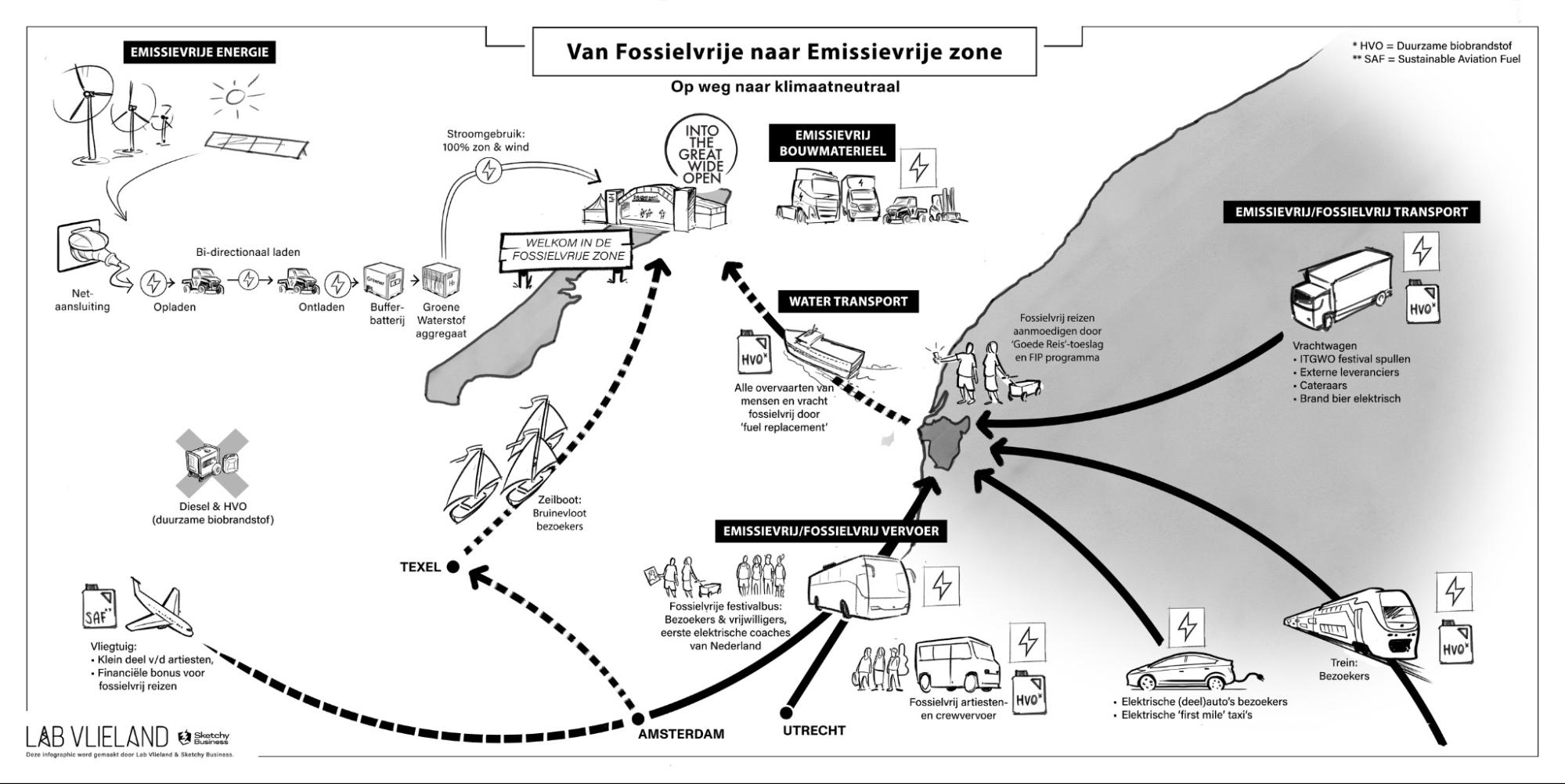
3. We are switching to fossil-free and preferably emission-free. Wind, sun, muscle power, green electricity, and hydrogen. And where that is not yet possible, sustainable biofuel (HVO B100)
4. What remains, we clean up. With ONCRA certification and Scature as the connector, we support natural CO2 storage projects in the highly fertile soil of regenerative farmers in the Northern Netherlands. This way, we remove carbon from the air long-term, while simultaneously helping to kickstart a new economy.
THE FERRY
Rederij Doeksen itself sails on 7% HVO. On top of that, we replace, through GoodShipping, all the diesel needed to sail all people - yes, including you - and all our belongings to Vlieland with HVO via GoodShipping. The crossing is therefore, in a sense, fossil-free. Not a final solution - that would be emission-free - but the best transition solution we have found so far.
THE EXTREMELY GOOD JOURNEY
The Good Journey surcharge is 15 euros per ticket. If you travel ‘fossil-free’, you simply get it back. This makes green options relatively cheaper and fossil options more expensive, reflecting the ‘true price’ better.
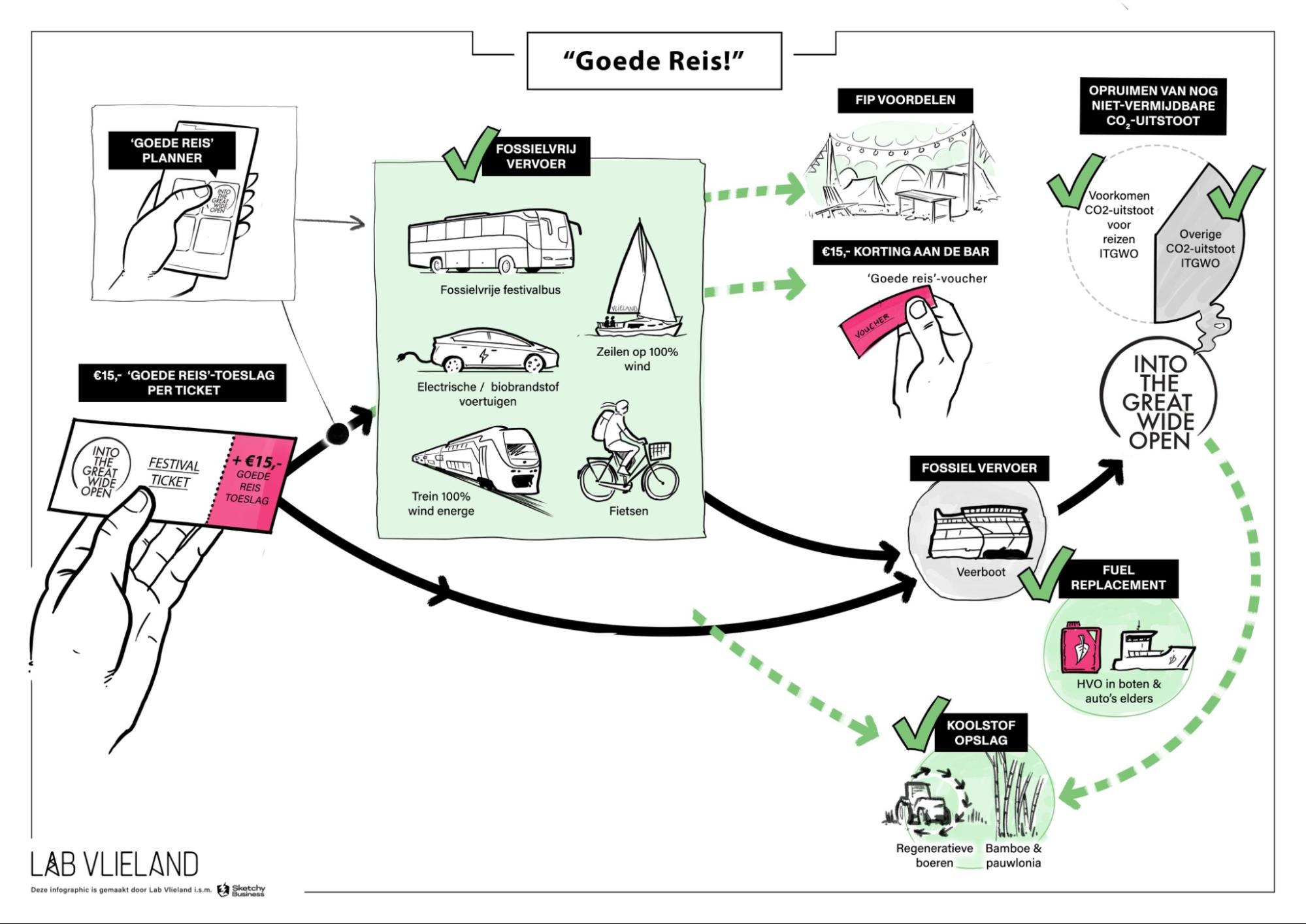
As a result, the festival buses (Arriva Touring) run much more frequently, and the ticket price remains at 22 euros. The first 100 tickets are sold with a 50% discount, and children ride for free. You simply buy your bus ticket at the same time as your festival ticket, so it is sorted in just one click. And of the over thirty buses, a number are running fully electric this year, and the rest fossil-free (HVO).
Additionally: shared electric cars from Mywheels with a significant discount (code; ITGWO-2026), our own NS travel page, carpooling via Slinger in electric and low-emission cars, cycling and walking routes, and for the true enthusiast, you can even go by sailboat.
With The Good Journey Planner (by Handpicked), you can find all these fossil-free travel options in an instant, so do make use of it.
New this year: renting tents at Camp Again. No more lugging around a tent, sleeping mat, and sleeping bag. Saves luggage, and therefore one less reason to take the car.
And then there is the FIP campaign. Fossil-free Important Person. If you travel green, you will be welcomed as a guest of honor on Vlieland: Good Journey ice cream, a green carpet, a dedicated entrance, spontaneous shuttles, and for a few lucky ones, even a luxury tent from de Waard. This year we have expanded the campaign further, with more benefits on the island itself.
Onwards to a completely fossil-free visitor journey. Who knows how far we will get.
ARTISTS ON THE ROAD
Artists also need to get to Vlieland. That is why we are introducing the Green Artist Touring Allowance: a green travel bonus. We have allocated 10,000 euros from the Transition Fund to financially reward artists who travel fossil-free. A plan to see how many artists adjust their travel behavior when you reward sustainable travel for what it is worth, which is a lot...
Additionally, sustainability is now standard in the artist contracts, via an updated Green Artist Offer Sheet.