Along the Lutinelijn (2)
Why hijacking helps to slow down

2025
In-depth
DATE
This summer, Mister Motley and Into the Great Wide Open once again join forces to publish the research of artists Sjoerd Willem Bosch and Sijas de Groot. They have spent several months on Vlieland for their new work Lutinelijn, which they will present within the art program of Into The Great Wide Open. This installation connects the maritime heritage of the sunken gold ship the Lutine (1799) with the landscape of Vlieland. Spread across the island and the festival site, four objects and stories mark the historical navigation line. In their joint exploration of slowness, memory, and orientation, Sijas and Sjoerd investigate how the civil beacon that once marked the site of the Lutine can take on a new role in the Wadden Sea area. In two contributions, they take the reader along their process, through heritage, during walks, and a longing for the idea of coming home on an island. Last month, their first essay could be read; today the second.
Lutinelijn – introduction
Along an invisible navigation line between the mudflats and the North Sea unfolds Lutinelijn – an art project by Sjoerd Willem Bosch and Sijas de Groot (Tussenland), developed for the art program of Into The Great Wide Open 2025. The installation connects the maritime heritage of the sunken gold ship the "Lutine" (1799) with the physical and inner landscape of Vlieland. Spread across the island and the festival grounds, four objects and stories mark the historical navigation line.
In this joint exploration of slowness, memory, and orientation, Sijas and Sjoerd investigate how the civil beacon can take on a new role as an artistic object in the Wadden area. In two contributions, they take the reader along in their process, through heritage, during walks, and a longing for the idea of coming home to an island.
Four places along the Lutinelijn
In this second part of Along the Lutinelijn, the four places that together form the installation Lutinelijn are central. During Into The Great Wide Open, we activate hidden remnants of old beacons and memories of the island with temporary objects and stories. The imaginary Lutinelijn arises by drawing a line between two beacons: the Lutinekaap and the Lutineveldkaap. Along this line, two other places connect the rhythm of life on the island with the gold of the Lutine. How do we make Lutinelijn tangible, where do we add something, and where do we let the landscape work for us?
The island as an archive: places and memories
Over the past six months, Vlieland has worked for us as an archive: a collection of stories, historical facts, memories, images, and reflections. Initially vague, a tangle. Later, the collection became clearer, and we discovered connections between the beacons and the landscape history of Vlieland. For example, how different versions of the beacons followed each other and how the forest plantation on Vlieland originated in the early twentieth century. We made the archive tangible with large maps and participatory walks. Now it is time to use the archive for a physical experience during Into The Great Wide Open.
Places have a memory. They carry stories, scents, and silhouettes within them, but also knowledge. If you are willing to listen or to look closely. In geography and anthropology, one speaks of sense of place: the emotional, cultural, and social significance that people assign to a place. Anthropologist Keith Basso described it from his work with the Western Apache: how every hill, rock, and spring carries a story and how these stories give direction to life.
"Wisdom resides in places. It's like water that never dries up. You have to drink deeply from places." - Keith H. Basso [1]
This idea touches us. Because we do it ourselves constantly: reading the landscape as a memory palace. A place becomes a marker in time, a carrier of what happened there before, grew, or what stood there. Along the Lutinelijn, we see how these places become crossroads of perspectives and interests. For islanders, they are part of a living memory and a shared identity. For visitors, they serve as landmarks in a temporary stay, moments of arrival and departure. For nature, it is the transitory structure in an ever-changing landscape. In one place, thus, different layers of meaning come together, sometimes reinforcing each other, sometimes countering each other and creating friction. Therefore, there is always tension in naming what heritage is. It takes courage to say what you preserve and anchor in the landscape.
Lutinekaap: the future of the beacon
In the ordinariness of life on the island, the Lutinekaap keeps surfacing. After a dive into the sea, during a walk through the campsite, or just in the distance, the Lutinekaap appears in your line of sight. It continually reminds us of the possible repurposing of this beacon.
Since the marker has been blown away, the Lutinekaap looks unfinished. A physical urge arises to complete it. Yet, we consciously choose not to do that just yet. For the festival, that would be too hasty, too thoughtless a decision, and for an outsider, it might give the impression that this becomes the new beacon.
From the dune crossing, you look out over the sea towards Terschelling. In your imagination, the Lutinekaap marks the position of the Lutine: the gold must be lying somewhere there. At the same time, you have a view of the 'original place' where the beacon once stood and the campsite - on the so-called gold coast: the most beautiful camping spots in the dune. The view provides a comprehensive perspective, making the place special.

Photo: Sjoerd Willem Bosch and Sijas de Groot
Something is truly happening around the Lutinekaap. The remains of the old marker have been set upright against the kaap this summer. By whom we do not know, but it seems as if someone wants to say: you are working on it, but so are we; we are keeping an eye on you. That makes it exciting. For Lutinelijn, we activate the place of the Lutinekaap as an invitation to a ritual. What do you take with you, and what do you leave behind in Vlieland? During the festival, we invite the audience to explore their horizon while reflecting. We now leave the remnants of the Lutinekaap as they are and add a reflection bench as a temporary kaap.
Sijas:
"This view, the image of the beach, and the gaze over the sea, is often my last sight before I go home. Usually, I take in the view one last time, as a moment of farewell, before I head to the boat. Often, a last dive into the sea follows as a farewell ritual."

But what does 'authenticity' mean when the Lutinekaap itself is already an interpretation? The beacon that stands there now was rebuilt in 1999 for the Lutine year. No drawings of the original beacon are known, only descriptions. The beacons built in the early twentieth century were made of tropical hardwood and were impregnated with creosote – a chemical process that is unimaginable today.
Lutineveldkaap: a foundation
The Lutineveldkaap is much less known on Vlieland. It is unclear when the Lutineveldkaap disappeared, yet the foot of the kaap has never been removed. In a young grove against the Havenweg, a steel pedestal, filled with concrete, is hidden.
On early postcards of Vlieland, the Lutineveldkaap towers like a frail twig above the young pine forest. Now this image is reversed: the forest with peaks of twenty meters makes the foot of the Veldkaap disappear into the ground. Yet, only that foot already gives us support. A strong foundation is crucial for a kaap. Not only must it be technically sound, the exact location is also important. This idea of a foundation inspires us to talk about settling in a place.

Photo: Sjoerd Willem Bosch and Sijas de Groot
The Lutineveldkaap hardly has any significance in the collective memory of Vlieland. It is something of the past. Yet, we read in the national newspaper archive Delpher that already in 1910, 'individuals' established beacons on their initiative. 'According to the report of the Inspector of the Pilotage Service, two beacons with black square screens have been established on Vlieland by individuals in the direction and approximately at the sites of the former Lutine and Veldkaap, measuring 9 and 10m high.' [2] Between the lines, we read as if the 'individuals' felt that the Lutine and Veldkaap belonged to Vlieland. The idea that we are not the first to take care of the Lutine beacons excites us.
In collaboration with Staatsbosbeheer, we mark the foot of the kaap by mowing part of the vegetation. We create a path around the very young pines to reach the foot. Here, we invite the festival audience to pause and look up at where the marker of the Lutineveldkaap was once visible. Around the foundation, there is space for a new island ritual.
Sijas:
"When I spend the first week of my holiday on Vlieland, thousands of memories from the island come to the surface. Sometimes it’s almost neurotic; I have to go by all the places and memories to remember how it was again. These experiences form the basis for the carefreeness of the island. They form a clear personal foundation. I am the island."

Photo: Sjoerd Willem Bosch and Sijas de Groot
Building like a beacon
A beacon is a recognizable structure where the visual and the technical work together. The different components are often built from a simple measurement system. This form inspires us to create temporary objects that activate Lutinelijn.
How do you build a kaap? With construction drawings and skilled contractors, constructing a kaap in the Wadden area was an expedition on the mudflats. Building a kaap balances between simplicity and complexity. Simple due to the materials and types of connections, but complex due to building in extreme locations and the weather conditions. Logically, a foundation, suitable height, and visible elements are designed to be present in the landscape; a beacon seems always to say: here I am!
The construction process itself is at least as meaningful. Is a beacon placed with a crane, or do dozens of people carry parts together to the right place? Just as raising a house in Amish communities is a community ritual, so too can building a kaap be a collective experience that connects landscape, technology, and community.
Marking a line
In our process, we have sought to understand what it means to follow and make lines visible. Lines are part of how one interacts with the landscape. We feel an affinity with the ideas of anthropologist Tim Ingold, who describes how lines are not abstract geometric shapes but living carriers of meaning. Lines only become active when you do something with them, whether walking or in relation to a craft or ritual.
We remember the navigation lines that dominate the sea charts in Museum Tromp’s Huys. Where does a navigation line begin? The lines seem to go on infinitely, crossing arbitrary other lines. The abstract lines only become concrete when they cross beacons. The kaap thus provides stability at sea and serves as a reference point for navigation.
The dramaturgy of Lutinelijn is determined by the island itself: four places spread over one and a half kilometers. The first three follow each other relatively quickly, but the fourth is a considerable distance away. This distance is not a conscious intervention of ours, but something that the island and the Lutinelijn seemed to have prescribed. Yet, this distribution fits the story we want to tell. When you are on the island for a longer time, the island itself starts to work: you slow down, you are grounded. A long period arises in which the mainland feels very far away. Perhaps that is why so many people come here and vacation here.
Mobile beacon on the mudflats
Sijas:
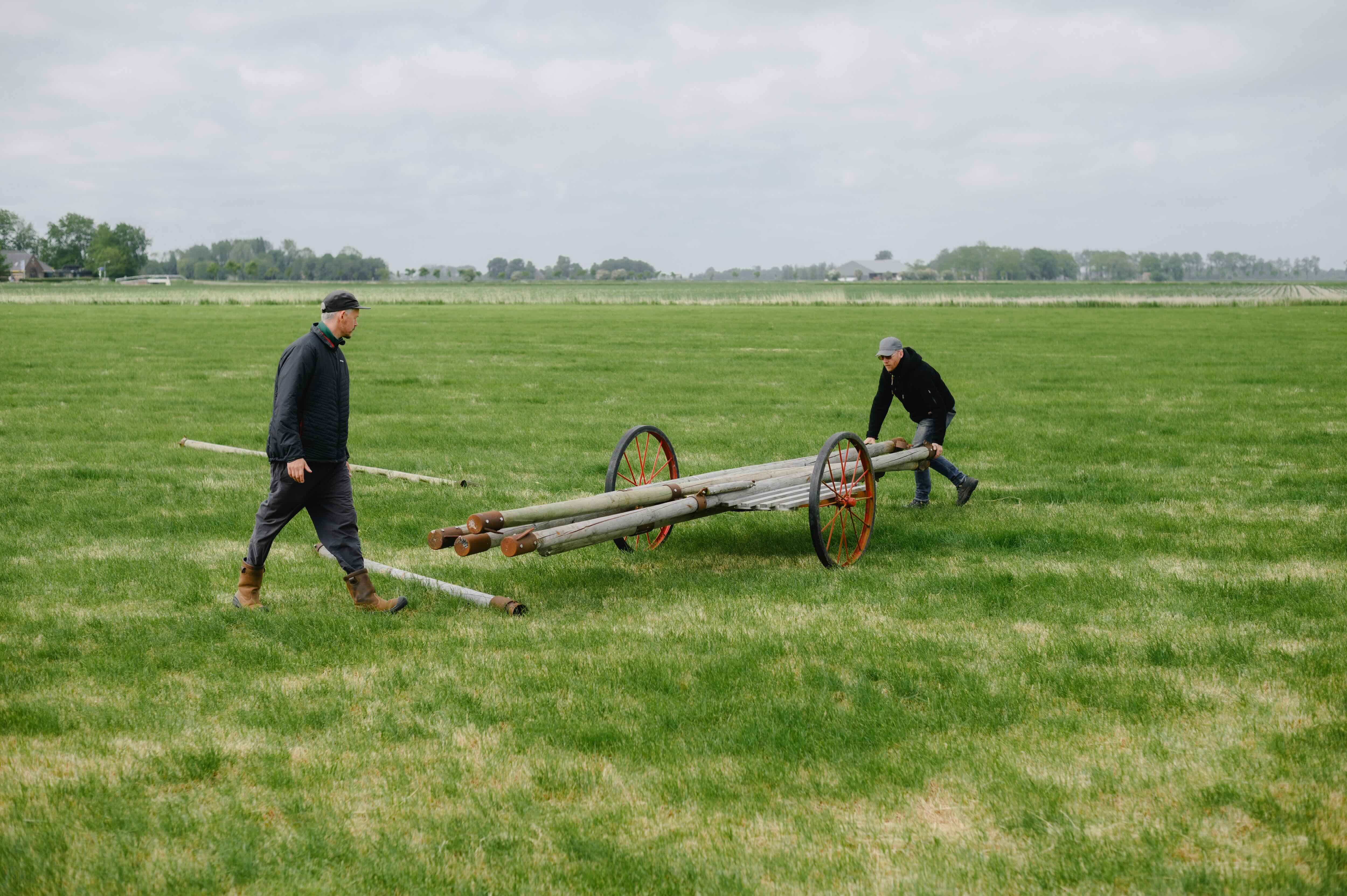
"After the performance KAAP (2022), which I created and performed in collaboration with the Peergroup, I had a beacon designed by visual artist Marc van Vliet. It is a runner, a jumper, smaller and more mobile than the large beacons that my grandfather's company used to build. The design had to fit the changing Wadden landscape, but for me, it was especially important that the beacon could easily be moved to new places. This way, it can be used at different locations to reevaluate its meaning and elicit stories. Its temporary character also makes it practically and substantively valuable: together with the community, the beacon can be built up and taken down, without permanently altering the landscape."


Photos: Casper Maas
At this moment, the beacon is traveling through Frisian villages, in collaboration with Stichting Romte and the Ministry of the Future. In each village, we build it together with residents and use it as a discussion space. There we talk about questions like: what values, topics, and stories do we want to anchor in our landscape so that we can give direction to the future as a community?
On Vlieland, this temporary beacon will soon mark the starting point of Lutinelijn. It is a landmark for festival visitors and islanders, a clear marking along the Wadden coast. It reminds us of the maritime history intertwined with Vlieland and the stories we anchor today for the future.
That this beacon now stands on Vlieland at the Wadden coast for a short period is a special moment for me. Five years ago, my quest began for my grandfather's family business and the meaning of the beacons he built. Now, on a site that holds much personal significance for me, stands a beacon that has arisen from that quest. Here, different layers come together: my family history, my work as an artist, and my relationship with this island. In this place, the beacon serves as a temporary axis mundi: a central point that connects people, stories, and landscapes.
The pit in the forest
Vlieland was long merely a sandbank. The monotonous pine forest has thus historically had something strange, considering how vast and dynamic the Wadden area is. Therefore, the rolling hills inspire us in the forest between the Kampweg and the festival stage The Open Place. The pits and mounds give us the feeling as if we want to sink into the island. Invisible, yet sheltered.
Here, on one of the mounds, a kaap might have once stood. Indeed, on archive maps, we find in the forest: ‘Kaap’. What type of kaap ‘Kaap’ was, we cannot trace. In sea almanacs, views with corresponding beacons were drawn. With almanac in hand, one could recognize the islands from the sea. In Spiegel van de Zuiderzee (2009), we find the views of Vlieland from the sixteenth century. Although this view differs by centuries from the ‘Kaap’ on the archive maps from a hundred years ago, the views show what the essence of beacons was in the Wadden area. In the emptiness above the horizon, a simple vertical interruption is enough to mark a place.

Image: Sijas de Groot and Sjoerd Willem Bosch
Now in the forest, through the vertical trunks, a horizontal interruption would provide a clear marker. For us, this coincides with the idea of the line and the feeling of wanting to sink into the forest. How can a spatial interpretation of a kaap capture this feeling in the pit in the forest?
Sjoerd:
"At the end of June, I gather dry twigs in the pit. Not to make a fire on the beach but for a model. I select them based on thickness. With a thickness of 3.5 centimeters, the twig becomes a log in the model. Measuring the trees and working in a scale model helps me direct the spatial experience of the place. How can I use the trees to hang a marker? What size can the work have between the trees? With simple battens, steel wire, and a wood fiber board, I make the pit visible. I crawl behind my camera and lower myself until I am, in a sense, sitting in the pit. Click. I lift the screen of my camera and look at the result. I think I see it; it could hang higher."

Photo: Sjoerd Willem Bosch and Sijas de Groot
Sounds from the landscape
Sijas:
"I often use audio to guide my audience through a landscape, to evoke the specific sense of place. Usually, such a walk lasts an hour and a half, at a slow pace, with headphones on and a route marked by stakes. A voice tells where to look, shares observations, information, and experiences linked to that place. Via GPS, the voice and sound are controlled, making it sometimes seem as if the narrator walks beside you, unfolding the landscape as you walk. Listening to the voice and sound helps you concentrate and direct your attention to what you see. Audio is a medium I often use: a way to not only look at the landscape but also truly dwell in it. The landscape opens up in a new way; a place you normally passed a hundred times gains depth, gets expanded.
For Into The Great Wide Open, working with good headphones is too much of a task. Also because festival visitors roam the island, and the work will often be listened to only fragmentarily. Therefore, we choose to play the sound through speakers so that visitors do not have to deal with picking up or returning equipment. The audio breathes freely in the landscape.
For Lutinelijn, we collaborate with sound artist Koen Kaptijn, who works with the landscape in his own way. This collaboration proceeds as follows: we record sound on location and ask Koen to respond to it. His sound layers give the landscape atmosphere and depth: large areas with plenty of air for voice and environment, a collage of field recordings, instruments, and soft radio noise. For Lutinelijn, he used: a singing bowl, claves, a solitary Fender Rhodes. The instruments are iconic and carry a period's imagery within them. The audio for Lutinelijn consists of four fragments for the four places. Together, they form a monument for past times: perhaps melancholic but with a vital undertow. Slow, inevitable fields in which you can drop an anchor, set up your camp. Look back one last time and then move on."
Building with the island
Sjoerd:
"The objects that activate the line are made on Vlieland. I find it important that the temporary beacons are made with material from the island. The material is already on the island and only needs to be processed. On Vlieland, Karel Nouta is someone who doesn't need an explanation. He makes woodwork from driftwood and island wood and offers us the opportunity to work with pine wood from Vlieland. He saws and planes scale parts into planks of ten centimeters wide. I may use his workshop behind the marina for a week.
In mid-August, I walk through the forest towards the marina on a Monday morning. It's early, and it feels like I am the first one walking through the forest today. I try to imagine how the ten-centimeter planks fit into a spruce tree. It reminds me of the different ways you can saw a tree into planks. You call that quarter-sawing or flat-sawing. It has to do with how the saw blade hits the fibers, perpendicular or parallel to the direction of the grain.
In the workshop, I inspect the wood and see that it is approximately sawn perpendicular to the direction of the grain, indicating: half quarter-sawn. I let the planks that will come next to each other vary in color and pattern. Thus, knots, red glows, and elegant flames alternate. I saw notches to allow half joints to be made. This way, the planks hold each other. Without glue, I use wooden dowels to fasten the planks together. Up close, those details will stand out, but from afar, the elements together form recognizable structures for commemoration or stillness."

Photos: Sjoerd Willem Bosch and Sijas de Groot
Heritage and making choices
Sijas:
"I often articulate this sentence. It sharpens my work ethic and reminds me to work carefully and as fully as possible:
"Determining what heritage is is an act, a conscious choice. Something that threatens to disappear gains meaning from a group and thus becomes valuable and worth preserving. This choice implicitly forms the identity of the group: we are the people who find this valuable for a specific reason."
To make such choices, you must learn to read the landscape. Understand how it was formed, which layers are hidden in it, and what connections it carries with stories, use, and memory. However, giving attention to one element in that landscape inevitably means that other elements fall out of view. Heritage selection is therefore also an act of omission.
With Lutinelijn, we again turn our gaze to the maritime heritage of the Lutine, precisely because it threatens to disappear, not just the story of the ship, but also the visible beacons that once marked the site of the wreck. By marking these places, we simultaneously name what remains invisible: the disappeared beacons, the unseen traces, the stories that received no monument. In that shift of focus, a new sense of place arises: a way of looking where the landscape itself may speak, and where memory and orientation continually reorganize. The work is therefore about giving a new, contemporary meaning to the gold of the Lutine. A meaning that connects with the current dynamics of the island, without forgetting the history and the original significance."

Photo: Sjoerd Willem Bosch and Sijas de Groot
We need beacons in our lives
Beacons remind us that in a constantly changing landscape, we need recognizable structures. They help us navigate, both literally and figuratively, and help us relate to place, time, and community. On Vlieland, this became visible along the Lutinelijn: each time we returned, the meaning of that line crystallized more clearly. The island functioned as an archive, where layers of history, nature, and culture come together.
But the question arises: what does a kaap mean today? Is it merely a nautical aid, or can it also refer to other forms of ‘gold’? Perhaps a kaap is no longer bound to traditional forms but can take on new meanings that fit a changing world.
In this, the position of us as makers plays a crucial role. As outsiders, we do not automatically have the right to determine how a beacon looks or what it symbolizes. That is precisely why the value lies in dialogue: a process in which islanders, designers, and landscape give meaning together. A kaap can then function as an axis mundi, an anchor point that provides both physical and symbolic orientation.
The most important question is therefore not just how we build a beacon but, more importantly, why and for whom. Perhaps a beacon can only be meaningful if those questions remain open, and the object continues to form in dialogue with the community and the landscape it marks.
Lutinelijn during ITGWO
Walk along the Lutinelijn with Sijas and Sjoerd during the festival – or walk the line on your own. The locations of the different temporary beacons can be found in the Into The Great Wide Open app.
The opening hours of the installation are
Thu 28 Aug 15:00 – 20:30
Fri 29 Aug to Sun 31 Aug 10:00 – 20:30.
On Friday, Saturday, and Sunday, you can join Sijas and Sjoerd at 14:00. You can register at the Kunstinfobalie, which is located along the Kampweg, next to Het Sportveld. The walk and the installation itself are accessible to everyone, even without a festival ticket. The walk lasts about an hour and a half.
[1] https://www.deuceofclubs.com/books/289wisdom_sits_in_places.htm?
[2] https://resolver.kb.nl/resolve?urn=MMTRES04:211299067
Sijas de Groot - tussenland.net - @sijaspaulus
Sjoerd Willem Bosch - sjoerdwillembosch.com - @sjoerdwillembosch
Tussenland - @tussenland