Koen Taselaar
And the pixel-eating loom

2025
Interview
DATE
WRITTEN BY
Ruben van Dijk
He was once an avid skater and designed almost two hundred posters for self-invented underground bands. Now Koen Taselaar weaves tapestries – sometimes up to twenty meters long. A thousand-year-old art that the Rotterdammer – 'visual provider' of Into The Great Wide Open 2025 – still approaches a bit like a skater.
Three and a half centuries after it was woven in Brussels, the famous series of tapestries The Hunt for the Unicorn was found in 1850 among some crates of potatoes in Aquitaine. Since it has been dusted off, botanists have discovered more than a hundred accurately depicted plant species in it – until they could no longer see the flowers through the millefleurs. To the amateur ornithologists reading this, the challenge is to spot all the bird species in the tapestry designed by Koen Taselaar specifically for Into The Great Wide Open.
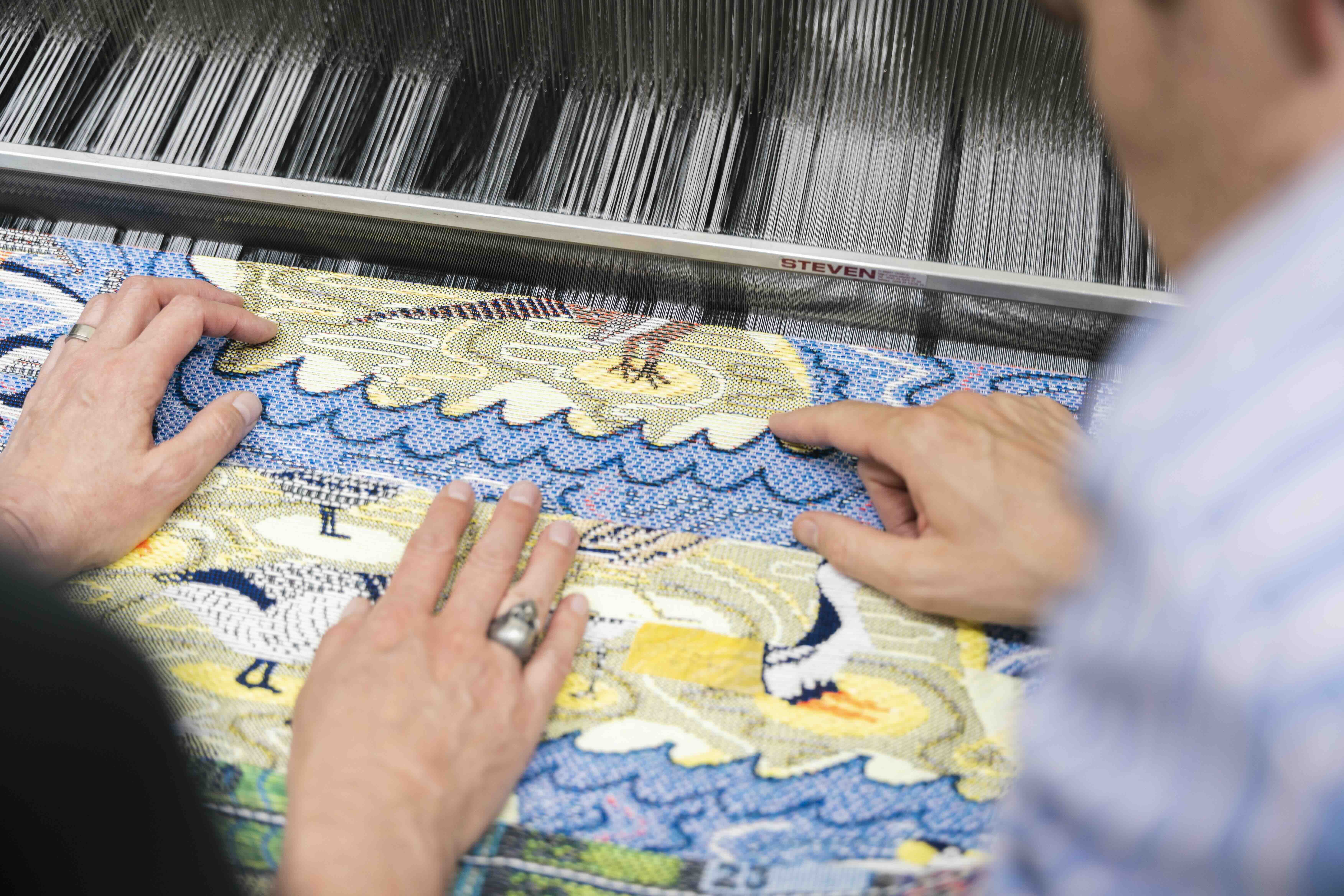
The Rotterdam artist relates to a tradition that is older than Vlieland (as well as Rotterdam) but is currently experiencing quite a renaissance. While it took five Flemish weavers about eight months to weave a rug four by five meters in size around 1500, Taselaar now has a computer for that. The pixel-devouring weaving machine – a jacquard loom – then does the rest.
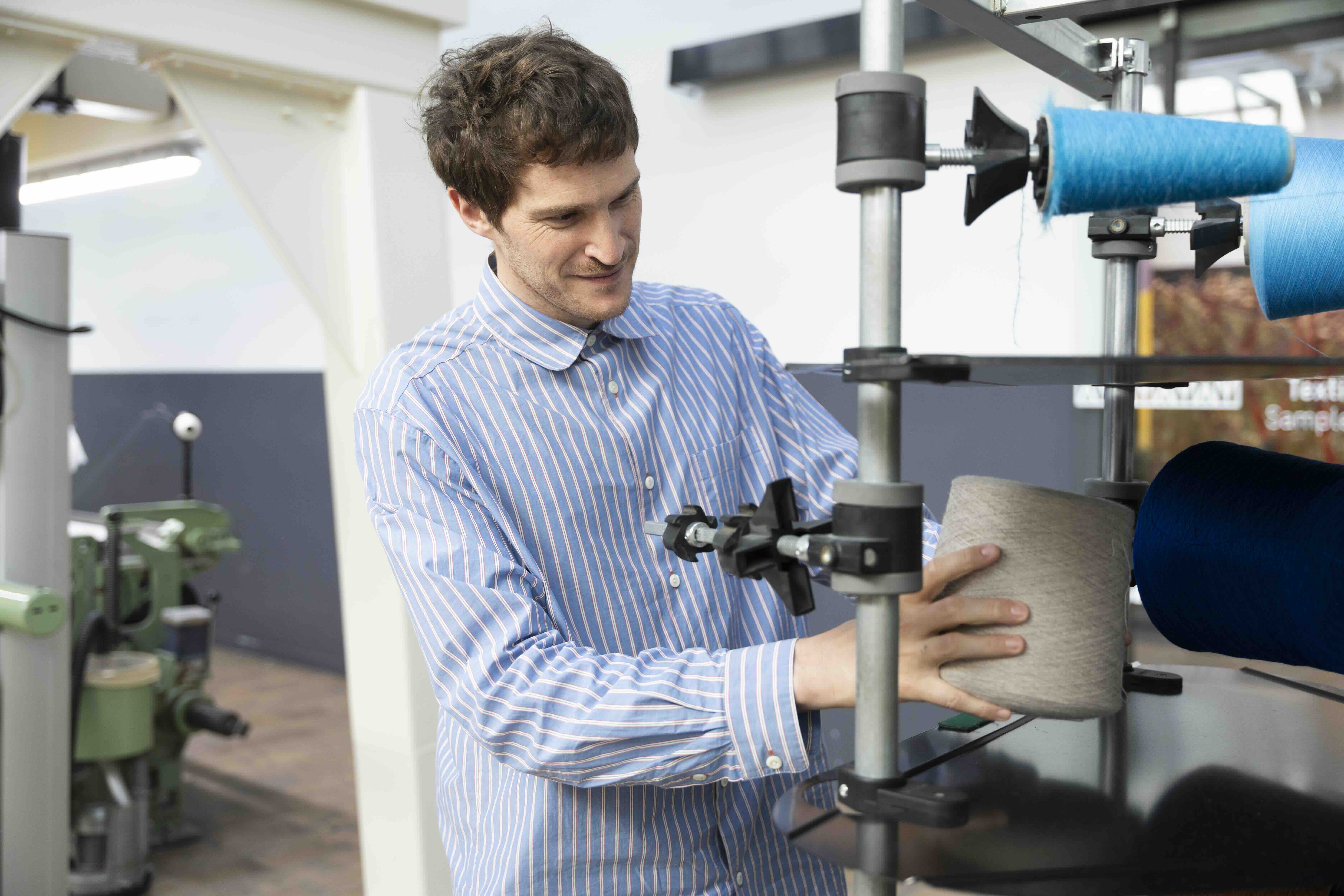
"I actually always start with a drawing,” Taselaar says via Zoom. "From that drawing, I then bring in other techniques." Almost pointillistically, he feeds his drawing pixel by pixel to the computer. What the jacquard loom then makes of it is yet another translation. "That reproduction process adds a whole unique language to such a drawing. I'm very interested in that play.”
King Pine Cone
The industriousness of Taselaar lies in that translation, the design, and the extensive research. For his work, he once delved into the history of Bauhaus, Tsar Peter the Great, and the end of the world. Now, he spent a week on Vlieland. He just rode around, listened to bird-spotting podcasts ("really nice niche, a new world"), studied old maps, and found the turbulent, shallow strait between Vlieland and Terschelling that the campsite Stortemelk is named after. The jagged lines with which Stortemelk is marked on hydrographic maps form the 'millefleurs' – the background pattern – of Taselaar's tapestry.
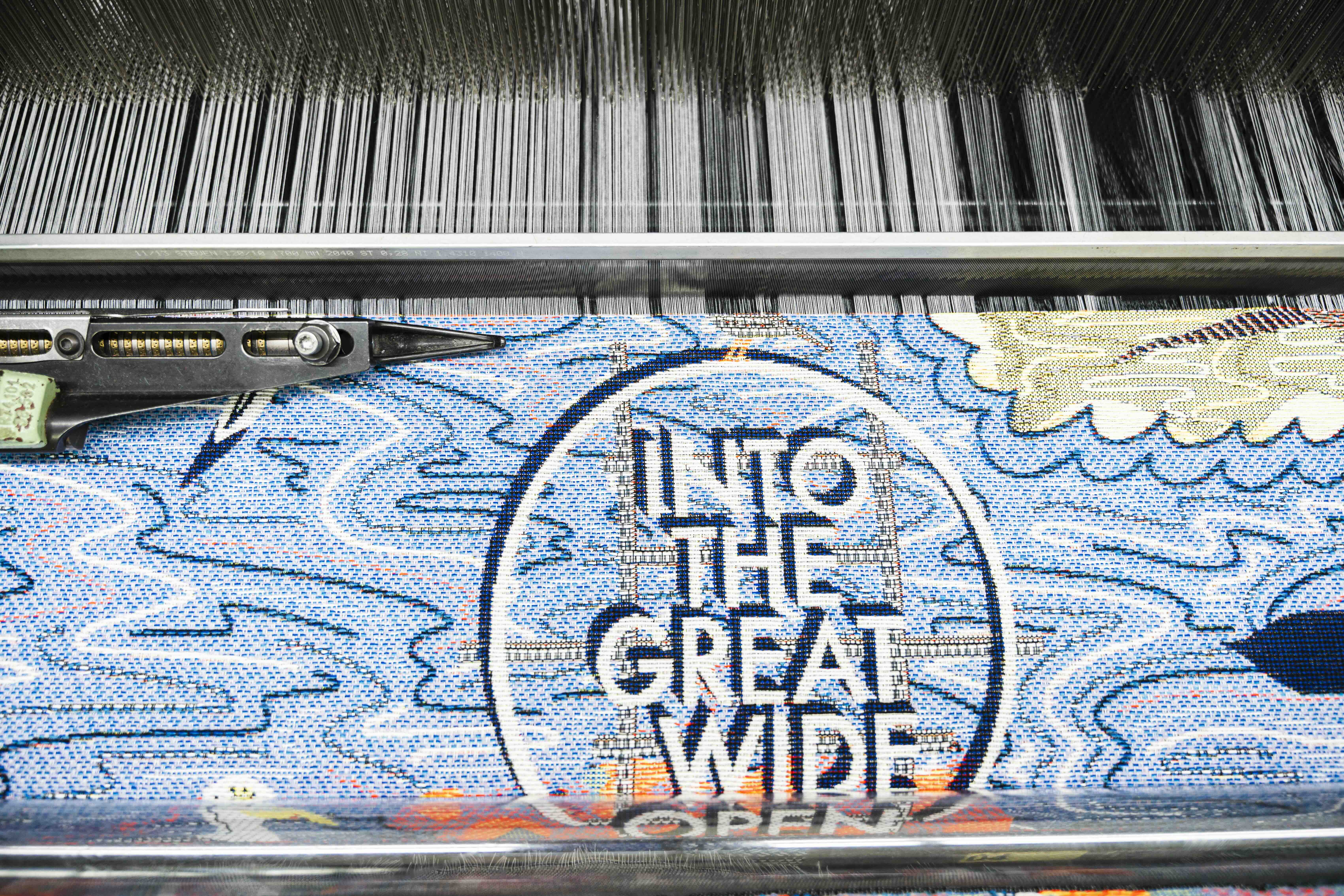
His four Vlielands bask in a "white, bright light" and have "not much color" – it was a challenge for Taselaar to find the right yarn for it. The garbage bin he was asked to incorporate into the tapestry, he camouflaged – characteristic of an island where people give themselves remarkably little space. "It's actually bizarre that, while everyone goes on beach holidays to Turkey or the Mediterranean, it is so quiet on Vlieland. It could have been the Ibiza of the Netherlands, but the success story is that it has remained very calm and small. It's quite a minimal place."
On one of the sandbanks, a giant pine cone can be found. "It seems that all the pine cones that are cleared for the festival are later put back. Apparently, that is a very important theme. That’s why you see a large pine cone sitting on its throne like a sort of king of the island. Thus, all kinds of fantasy stories arise."
King Pine Cone is the mythical being of the Vlieland tapestry – just like the unicorn or the seven-headed dragon were in the tapestries of old. "For me, it feels especially like an 8-bit computer game," says Taselaar. When he delved into the late medieval Flemish style for his recent solo exhibition Ornamental Slapstick (2023), Taselaar realized how much the old weaving reminded him of video game design. "If you look at those fourteenth-century tapestries, or even older, you see that they are built up in colors and areas. It’s like a sort of pixel drawing with stitches. Perhaps those modern techniques also emerged from those old things."
Fooling Around
It is not an far-fetched comparison: when Joseph-Marie Jacquard sought a way to simplify the weaving process of tapestries at the end of the eighteenth century, he had his machine driven by punch cards. Not only was his jacquard loom revolutionary in the textile industry, but he also laid the foundation for the first computers – about 150 years later.
Jacquard looms have also existed in electronic form since the nineties. This made the technique accessible to Taselaar – and to more and more artists. "With those punch cards, it was so expensive to experiment. Now we are at a point where we can also play around with it and make unique things.”
The relative accessibility brings the former skater back to the surface. "The best part about skateboarding was finding new places to do something. That you have to take into account what is given to you, but you will try and see where you end up."
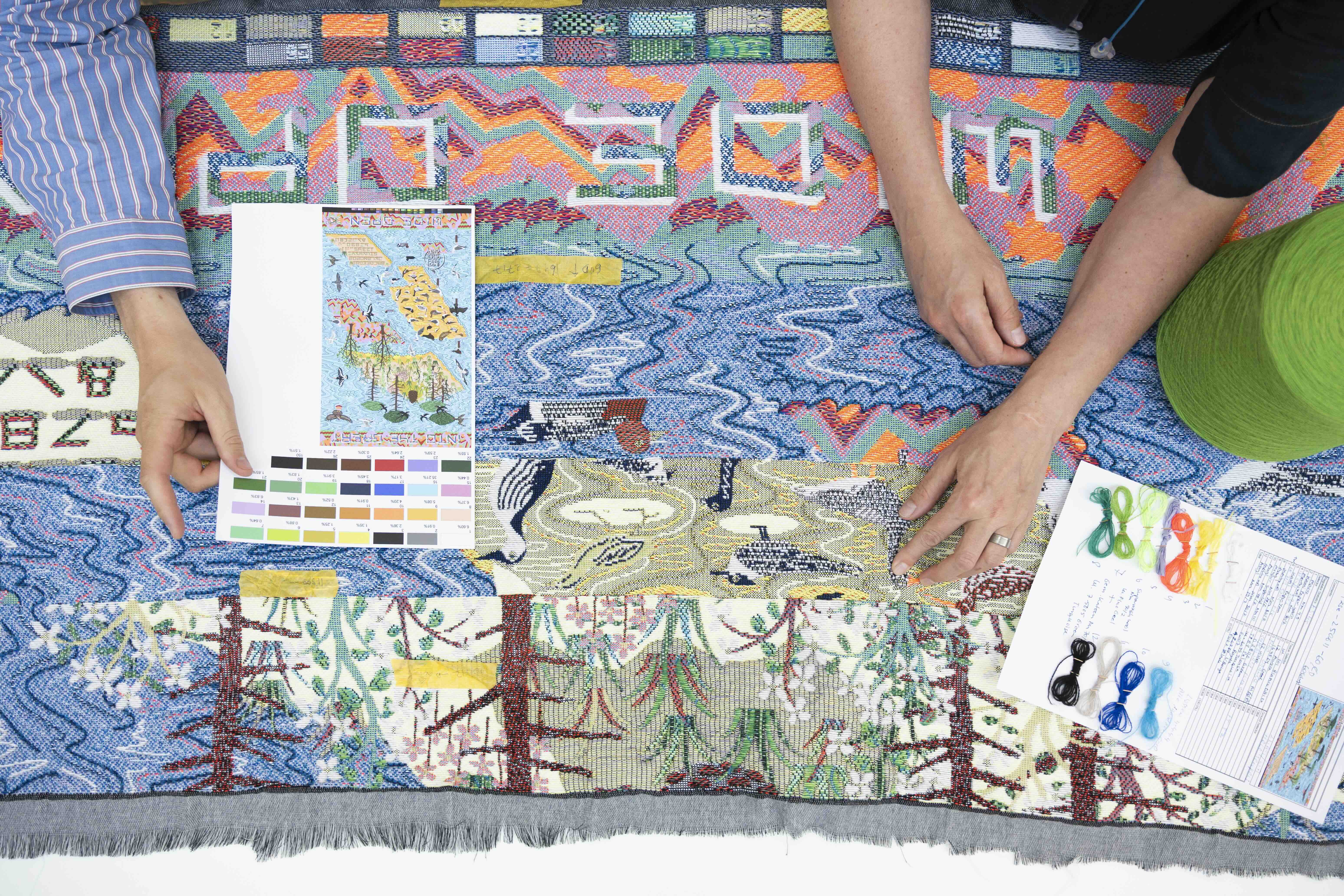
The tapestry for Into The Great Wide Open is already finished during our conversation. Or rather, finished. Actually, his latest experiment is still in full swing, says Taselaar. "It is a rug that is partially functional, a stepping stone in the merchandise. Once the rug is finished, you will scan it again and then print it again, and so on. It’s a kind of Chinese whispers. For example, there is a font in it, that little island at the bottom right, which is a building block to go further. I'm very curious if that’s going to work." If it doesn’t work, it at least doesn't cost punch cards – or five Flemish weavers many months of hard work.
IMAGE CREDITS: Patty van den Elshout i.o.v. TextielMuseum
CREDIT: The tapestry was created in collaboration with the TextielLab, the professional workshop of the TextielMuseum.